

Fan Laws: How Small Speed Changes Create Big Power Demands
Published on 19 Aug 2026
At RHF Fans, we have years of experience designing and installing industrial fans, so we know how even relatively small changes in fan speed can have a large effect on performance and energy consumption. A fan running just 10% faster does not simply move 10% more air or use 10% more power. The relationships between speed, airflow, pressure and power are much more significant.
This is where the fan affinity laws work as a useful instrument for engineers and system designers. They provide a straightforward way to understand how changes in fan speed, impeller size and operating conditions affect fan performance.
Although modern fan selection software can perform detailed calculations, understanding the basic principles behind the fan laws helps engineers make better decisions on selecting, controlling or modifying industrial fans.
What Are the Fan Affinity Laws?
The three fan laws show that airflow, pressure and power do not increase at the same rate as fan speed. This is the key principle behind why relatively small speed increases can considerably affect energy consumption.
Ultimately, the fan affinity laws provide a simple way to understand what happens when a fan's operating conditions change. The first law shows that airflow changes directly with speed. The second shows that pressure changes with the square of speed. The third shows that power changes with the cube of speed.
They are especially useful when predicting how a fan will perform when its speed or size changes from a known operating point.
In simple terms, the three main laws describe the relationship between:
- Fan speed and air volume
- Fan speed and pressure
- Fan speed and power
Together, they provide a useful way to predict the consequences of changing fan speed without having to start the selection process from scratch.
The laws are most reliable when comparing geometrically similar fans or the same fan operating at different speeds, with other conditions such as air density remaining comparable.
The First Fan Law: How Does Fan Speed Affect Airflow?
The first law describes the relationship between fan rotational speed and volumetric airflow.
For the same fan and operating conditions, define Q1 as original airflow and Q2 as new airflow, and similarly N1 as original speed and N2 as new speed:
Q2 = Q1 x (N2 / N1)
This means that airflow changes directly in proportion to fan speed.
For example, if a fan's speed is increased by 10%, its theoretical airflow will also increase by approximately 10%.
This makes the first law particularly useful when working with variable speed drives (VSDs). If an engineer knows the airflow required from a fan, the relationship can help determine the approximate fan speed required to achieve it.
However, increasing airflow is only part of the story. The pressure and power requirements increase much more rapidly.
The Second Fan Law: How Does Fan Speed Affect Pressure?
The second fan law describes the relationship between fan speed and pressure. Unlike airflow, pressure changes with the square of fan speed. Here, P1 is the original pressure, and P2 is the new pressure:
P2 = P1 x (N2 / N1)^2
Pressure increases much faster than airflow as fan speed rises. A 10% increase in speed produces about 21% more pressure, while doubling the speed increases pressure by a factor of 4.
We would use this law when assessing whether a system can accommodate changes in operating conditions. Increasing fan speed may provide additional airflow, but it also creates considerably more pressure within the system.
The Third Fan Law: Why Does Fan Power Increase So Quickly?
The third fan law is the most important when evaluating energy consumption.
Fan power varies with the cube of rotational speed:
Power2 = Power1 x (N2 / N1)^3
That cubic relationship is the reason fan speed deserves particular attention when considering energy efficiency. A seemingly modest increase in speed can require a disproportionately large increase in power.
For example, increasing fan speed by 10%:
1.10³ = 1.331
Means the theoretical power requirement increases by approximately 33%.
This is why fan speed control needs to be considered carefully in industrial systems. A small reduction in speed, on the other hand, can produce marked energy savings when the system can operate effectively at the lower speed.
Why Do Small Speed Changes Create Big Power Demands?
The three laws present a clear progression:
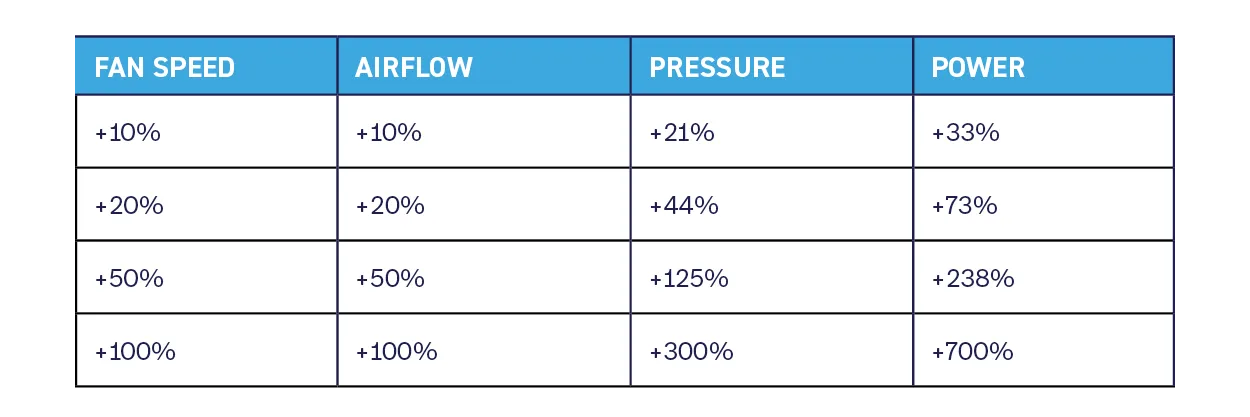
These figures illustrate why fan selection and speed control are so important.
A fan operating 10% faster may deliver only 10% more air, but the pressure requirement increases by around 21% and the theoretical power requirement by around 33%.
such asIn practical use, actual results can vary because systems are affected by factors including system resistance, efficiency, air densit,y and the specific fan operating point. Still, the affinity laws provide a useful way to understand the underlying relationships.
What Decision Can the Fan Affinity Laws Help You Make?
The fan affinity laws can help engineers determine whether changing fan speed is an appropriate way to achieve a required change in system performance.
variable-speedFor example, when a system requires increased airflow, the fan laws can help determine the corresponding increase in fan speed, the additional pressure generated, and the extra motor power that may be required. Engineers can use the laws to assess whether the existing motor and variable speed drive are suitable for the new operating point, whileprovidingg a clearer understanding of the potential energy implications of increasing fan speed. They can also work in the opposite direction.
Can Affinity Laws Compare Two Different Fan Sizes?
Yes, but there is an important qualification: the fans need to be geometrically and dynamically similar for the affinity-law relationships to provide a meaningful comparison.
When comparing similar fans of different sizes, these relationships help predict how changes in impeller diameter affect airflow, pressure, and power. These relationships can help designers compare a known, tested fan with another similar fan of a different size and estimate its likely performance.
Why Are the Fan Laws Important for Industrial Fan Selection?
Understanding the fan laws gives engineers a better appreciation of the relationship between airflow, pressure and energy consumption.
A system does not operate in isolation. Changing one parameter can affect the entire system. Increasing fan speed can increase airflow, but it can also substantially increase pressure and power demand. Similarly, reducing speed can offer considerable energy-saving potential if the resulting airflow and pressure remain suitable for the application.
This is particularly applicable in industrial situations where fans may operate for long periods. Even a relatively small change in operating speed can greatly affect annual energy consumption. The fan laws can therefore support decisions around fan selection, airflow adjustments, motor selection or VSD settings.
Let RHF Fans Guide You on Fan Performance
When selecting the best industrial fan for your application or planning an update to your fan systems, understanding the affinity laws helps you make more informed decisions for optimal output. howIf you are in n of a new industrial fan or want to understandhowf fan speedaffectsn performance and energy consumption, contact our team, who will help you assess your requirements and apply the fan laws to your specific application.